Wedding ceremonies trace their origins back over 4,000 years to ancient Mesopotamia, where unions were formalized through legal contracts. Traditions like exchanging rings symbolize eternal love, while the white dress gained popularity after Queen Victoria wore one in 1840. Events by Dubsdread in Orlando, FL honors these timeless customs through elegant, meaningful celebrations.
Wedding ceremonies trace their roots across thousands of years of cultural, religious, and historical practice, with widely recognized traditions — such as walking down the aisle, exchanging vows, and the first kiss — each carrying distinct symbolic meaning rooted in ancient beliefs about love, commitment, and covenant.
Wedding ceremony traditions carry centuries of meaning, shaped by cultural shifts and practical origins that modern couples rarely consider. From the processional walk to the exchange of rings, each moment in a ceremony tells a story. Events by Dubsdread specialists help couples understand and honor these traditions at every celebration.
Key Takeaways
- Walking down the aisle has shifted from a formal transfer of responsibility to a deeply personal expression of love and support.
- The bride traditionally stood on the left and the groom on the right — a custom rooted in a groom’s need to keep his sword hand free.
- The wedding processional signals to all present that a sacred, witnessed commitment is about to be made.
- Exchanging vows and rings transforms private promises into public ones, witnessed by family, friends, and faith.
- The first kiss concludes the ceremony as the couple’s first act in their new life together.
Why Do Wedding Traditions Still Matter Today?
Wedding traditions remain a powerful force in modern celebrations because omitting even one can draw strong reactions from guests — from raised eyebrows to outright gasps of surprise. These customs carry emotional weight that extends far beyond personal preference.
The staying power of wedding traditions is no accident. Couples have been marrying since at least 2350 B.C. The rituals that developed across those centuries are rooted in religion, culture, and history. That depth of origin gives each tradition a sense of meaning that modern couples still find compelling.
Why Do Guests React So Strongly When Traditions Are Skipped?
Wedding customs are so deeply embedded in collective expectations that their absence feels conspicuous. Guests arrive with a mental script shaped by generations of shared cultural experience. When a familiar ritual disappears, the gap is noticeable — and sometimes unsettling.
Do Wedding Traditions Look the Same Everywhere?
Not at all. Wedding customs vary widely across cultures, ethnicities, religions, countries, and social classes. A tradition considered essential in one community may be entirely absent in another. This diversity reflects the rich, layered histories that different societies bring to the act of marriage.
For couples planning their celebration, understanding the origins of each tradition helps inform which customs feel personally meaningful. Events by Dubsdread guides clients through these decisions with experienced coordinators who balance timeless ritual with individual vision across three stunning Central Florida venues — Historic Dubsdread, Azalea Lodge at Mead Botanical Garden, and The Highland Manor — ensuring every detail serves the couple’s story.
Walking Down the Aisle
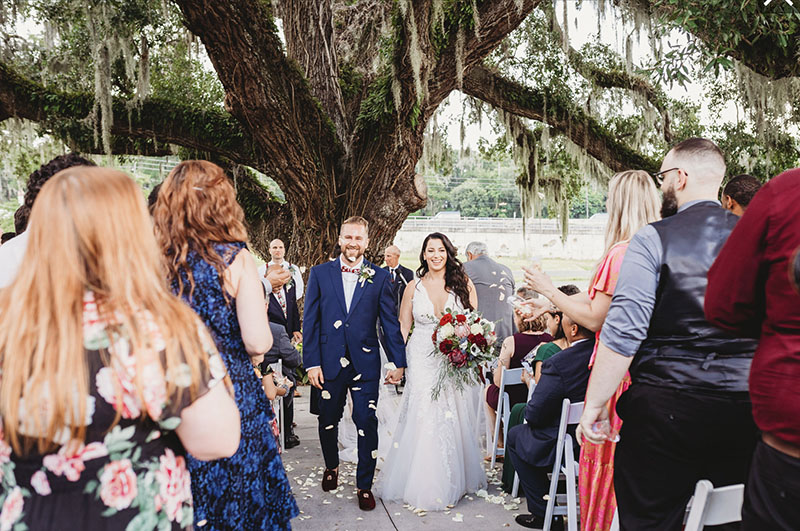
Walking down the aisle marks the beginning of a new journey together — the moment a bride (and increasingly, both partners) moves from one chapter of life into the next. It is one of the most visually powerful moments of any ceremony, and its meaning has evolved considerably over time.
What Were the Historical Origins of the Aisle Walk?
Historically, fathers escorted their daughters down the aisle as a formal transfer of responsibility. The gesture carried legal and social weight: a daughter was being handed from her father’s care to her husband’s. It was less a celebration of love and more a structured exchange between families.
How Is the Aisle Walk Understood Today?
Today, the tradition has shed its transactional roots. Walking down the aisle is now widely understood as a show of love and support — a parent or loved one accompanying someone they cherish toward one of life’s most significant moments. Many couples also choose to walk together, reflecting a partnership built before the ceremony even begins.
Standing on Opposite Sides
The placement of the bride and groom at the altar is one of those details guests rarely question — yet its origin is surprisingly practical. Traditionally, the bride stands on the left and the groom on the right.
Why Did the Groom Stand on the Right?
The reasoning traces back centuries to a time when personal safety was a genuine concern at public gatherings. The groom stood on the right side of the altar to keep his sword hand — his right hand — free. Should a threat arise, he could draw his weapon without hesitation to defend his bride. What began as a tactical stance became a ceremonial standard that persists to this day.
Does the Tradition Still Hold Meaning?
For most modern couples, the placement is simply custom. But understanding its origin adds a layer of meaning: the groom’s position was once a literal declaration of protection. Many couples who learn the history find it lends a quiet, symbolic depth to an otherwise overlooked detail.
The Wedding Processional
The wedding processional is more than an entrance — it is the ceremony’s formal opening, signaling to everyone gathered that something sacred and significant is about to take place.
What Is the Meaning Behind the Processional?
The processional represents entering into a sacred covenant. The deliberate, measured pace of the walk is intentional: the slow movement gives every guest in the room a moment to witness the weight of the commitment being made. It transforms the act of walking into an act of declaration.
How Does the Processional Set the Tone for the Ceremony?
The music, the pace, and the order of entry all contribute to the processional’s power. As each person takes their place, the room quiets and the significance of the occasion becomes tangible. By the time the couple reaches the altar, every witness understands they are present for something that matters.
Giving Away the Bride
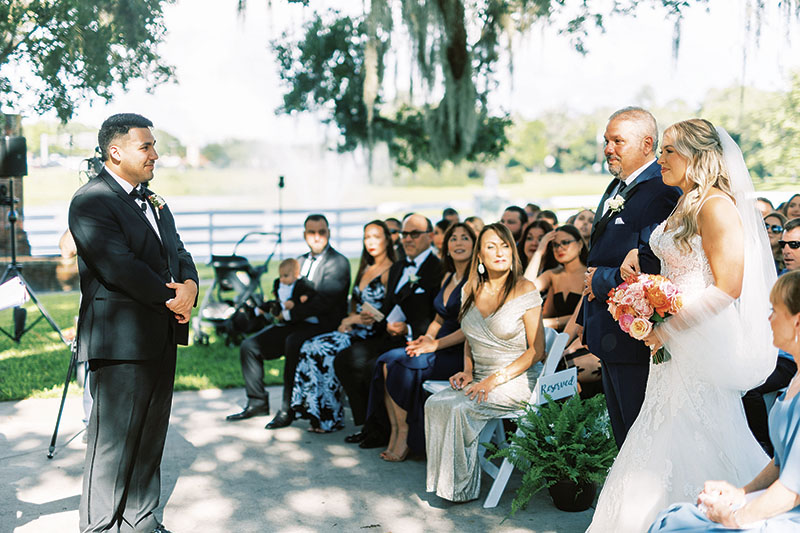
Few traditions in a wedding ceremony have shifted in meaning as dramatically as the giving away of the bride. What was once a legal formality has become one of the ceremony’s most emotionally resonant moments.
What Were the Original Roots of This Tradition?
Originally, giving away the bride was a legal transfer of guardianship. A father formally handed his daughter — along with her legal standing and property rights — to her new husband. The gesture was binding in a way that had real social and legal consequences.
What Does It Mean Today?
Today, the tradition has been reframed entirely. Rather than a transfer of ownership, it is more commonly understood as a parent’s blessing and expression of support. Many families adapt the moment further: both parents may escort the bride, a mother may walk her son, or couples may choose to walk together. The underlying sentiment — that loved ones are releasing someone they cherish into a new life — remains deeply meaningful, whatever form it takes. At venues like Historic Dubsdread and The Highland Manor, Events by Dubsdread specialists work closely with families to honor these personal adaptations within the flow of the wedding ceremony.
Exchanging Vows
The exchange of vows is the verbal and spiritual heart of the wedding ceremony. It is the moment when the couple turns toward each other and speaks their promises aloud — in the presence of the people who matter most.
Why Are Vows Spoken Publicly?
Vows are public promises, witnessed by family, friends, and often by God. That audience is not incidental — it is the point. The witnesses gathered in the room serve as a community of accountability. By hearing the vows spoken aloud, they become part of a shared covenant, bound by their presence to support the couple in honoring those words.
How Have Wedding Vows Changed Over Time?
Traditional vows were largely standardized by religious institutions, with language that has remained remarkably consistent for centuries. Today, many couples write their own vows, personalizing the promises while preserving the structure of public commitment. The words may change; the witnessed nature of the exchange does not.
Exchanging Rings
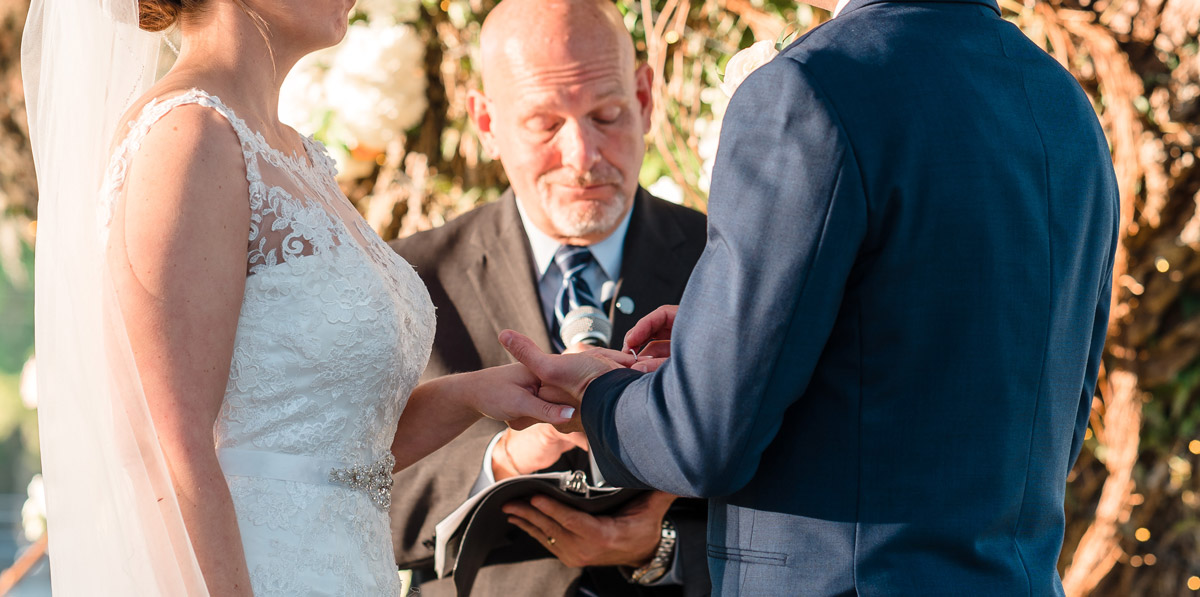
The exchange of rings is one of the most universally recognized symbols in a wedding ceremony — and its meaning is encoded in its form.
What Do Wedding Rings Symbolize?
Wedding rings represent endless love and commitment. The circular shape carries no beginning and no end, making the ring a physical embodiment of an unbroken bond. Wearing it on the left hand’s fourth finger — the “ring finger” — connects to the ancient belief in the vena amoris, or vein of love, thought to run directly to the heart.
Where Does the Ring Exchange Tradition Come From?
The practice of exchanging rings dates back to ancient Egypt, where rings woven from reeds and hemp were exchanged as tokens of eternity. The Romans later adopted the tradition, using iron rings to signify permanence. Over centuries, the materials became more precious, but the symbolic meaning remained constant: a circle given and received as a promise that does not end.
The First Kiss
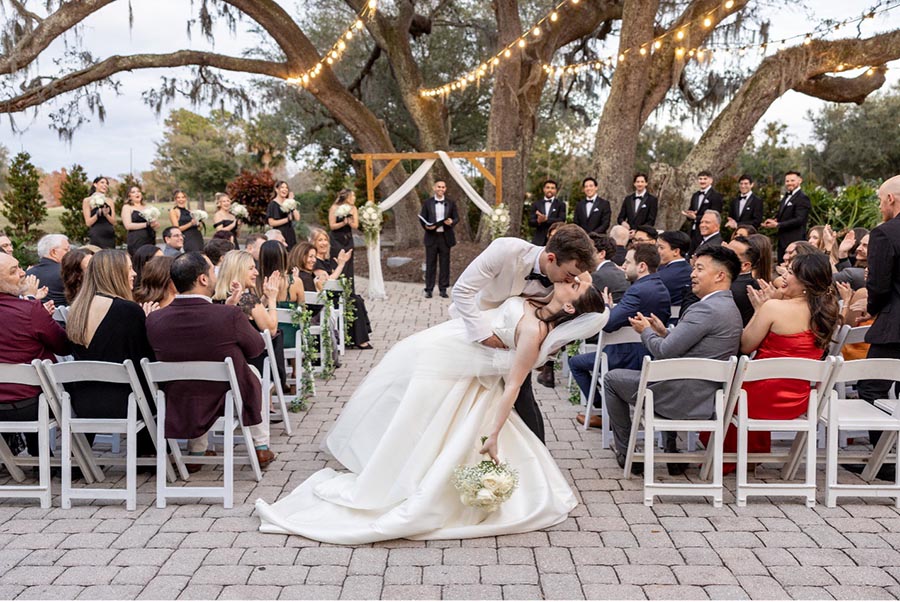
The first kiss as a married couple is the ceremony’s closing act — and one of its most anticipated moments.
What Is the Meaning of the First Kiss?
The first kiss marks the couple’s first act as a married couple. It is a transition: the ceremony has been spoken, the vows have been witnessed, and the first kiss seals what has been declared. In this sense, it functions as the ceremony’s punctuation — the moment that closes one chapter and opens another.
Why Did the First Kiss Historically Seal the Marriage Covenant?
Historically, the first kiss carried legal and spiritual weight. In many traditions, a kiss was the act that sealed the marriage covenant — completing the contract and making the union official in the eyes of the community and the church. In Roman law, a kiss exchanged at betrothal gave the agreement legal force. That gravity has softened over time, but the significance of the moment has not. Today, the first kiss remains the ceremony’s most celebrated beat — the instant when the room erupts, and the couple’s new life together begins.
Wedding ceremony traditions endure because they anchor our deepest values — commitment, family, community, and love — in ritual and symbol. Whether walking an aisle, speaking vows, or exchanging rings, these practices connect us to generations past while creating meaningful moments we carry forward. Understanding their origins enriches the significance of each gesture, transforming ceremony elements from mere custom into intentional expressions of who we are and what we promise. As you plan your celebration, honoring these traditions — or thoughtfully reimagining them — ensures your ceremony reflects both heritage and personal meaning.
FAQ
What is the significance of walking down the aisle?
Walking down the aisle marks the beginning of a new journey together. Historically it represented a formal transfer of responsibility from a father to a new husband, but today it is widely understood as a loving escort and expression of support.
Why does the bride traditionally stand on the left?
The bride stands on the left so the groom can occupy the right side — keeping his sword hand free to defend her if needed. The tradition dates back centuries and has become a ceremonial standard most couples follow today.
What is the purpose of the wedding processional?
The processional signals to all gathered witnesses that a sacred, significant commitment is about to be made. The slow, deliberate pace gives guests a moment to absorb the weight of the occasion before the couple reaches the altar.
Why are wedding vows spoken out loud in front of guests?
Vows are public promises witnessed by family, friends, and often by God. The presence of witnesses is intentional — it creates a community of accountability that supports the couple in honoring their commitment.
What do wedding rings represent?
Wedding rings symbolize endless love and commitment. The circular shape has no beginning and no end, making it a physical expression of an unbroken bond between two people.
Conclusion
Wedding ceremony traditions endure because they anchor our deepest values — commitment, family, community, and love — in ritual and symbol. Whether walking an aisle, speaking vows, or exchanging rings, these practices connect us to generations past while creating meaningful moments we carry forward. Understanding their origins enriches the significance of each gesture, transforming ceremony elements from mere custom into intentional expressions of who we are and what we promise. Events by Dubsdread brings this depth of tradition to life at three exceptional Orlando-area wedding venues — Historic Dubsdread, Azalea Lodge at Mead Botanical Garden, and The Highland Manor — where experienced coordinators help couples honor these customs in a setting as meaningful as the ceremony itself.